
Consultations and follow-ups are free
Most pages about miraDry in London lead with "82%", some add an 89% odour figure, and none of the three top-ranking miraDry pages we read lists who should not have the treatment, what the rare side effects are, or whether the NHS offers it. This guide is written by the team that runs miraDry at our clinic in the Harley Street medical district and reviewed by our clinician. It gives you the trial figures with their sources, NICE's view, the London prices we found, the manufacturer's own list of risks, and a straight answer on one session or two.
What miraDry is
miraDry is a device made by miraDry, Inc. of San Jose, California. A handpiece is placed on the underarm skin, draws the skin up by vacuum against a cooled plate, and delivers a few seconds of microwave energy at 5.8 GHz. Water-rich tissue absorbs microwaves and fat absorbs little, so the energy is concentrated at the depth where the sweat glands sit, while the surface is protected by the cooling. The glands are heated enough to stop working. The manufacturer says they do not grow back; the only published tissue sample we found is from one patient, taken 105 days after treatment, with no sweat glands visible.
The treatment is for the underarms only. The device's label says plainly that it must not be used for sweating of other body areas or for generalised sweating, and the manufacturer's own wording outside the US describes its use as primary axillary hyperhidrosis in adults. Hands, feet, face, back and chest are not miraDry areas, whatever you may read elsewhere.
Our site and the manufacturer's say your body has two to four million sweat glands and about 2% of them are in the underarms, and that treating them does not change how you cool down; we have not traced that figure to a study. In the trials, sweating elsewhere increased in a small number of people; we come back to that below.
Does miraDry work?
Yes, for most people, and the honest version of the numbers is more useful than the headline.
- The "82%". In the manufacturer-funded study behind the figure (Hong, 2012), 31 adults had one to three sessions and were followed for a year. Weighed sweat fell by 81.7% to 83.1% from baseline at every visit, and 90% of them rated their sweating as tolerable or unnoticeable at twelve months. There was no comparison group.
- The sham-controlled trial. In the pivotal trial (Glaser, 2012), 120 adults with severe underarm sweating were randomised to the real treatment or a sham. At 30 days, 89% of the treated group rated their sweating tolerable or unnoticeable against 54% of the sham group, and the treated group held at 74% at three months and 69% at a year. On weighed sweat the difference from sham was not significant at six months, a figure NICE recorded in its 2017 review before calling the evidence inadequate in quantity and quality. The trial was funded by the manufacturer and used an earlier version of the device.
- Longer follow-up. A telephone survey of 18 patients about three years after treatment reported a mean sweat reduction of 61% to 70%, and a Swedish series of 103 patients found the severity score still improved at three years, though only about half of those contacted answered. A two-year company-cited follow-up exists, but we could not read it and do not quote it.
- Odour. The manufacturer's "89% odour" figure comes from a short report we could not verify. In the 31-patient study, the share of people who said their odour was not noticeable rose from 13% before treatment to 61% to 74% afterwards. The one trial submitted to the US regulator on odour missed its main target, and the regulator allowed only the words "may reduce underarm odor". A Copenhagen trial that treated one underarm with miraDry and the other with botulinum toxin found the odour reduction lasted a year only on the miraDry side.
- Hair. In the US the device is also cleared to reduce underarm hair, with a 75% average reduction in hair count at a year in the manufacturer's 56-person study submitted to the US regulator of skin types I to IV. In the UK the manufacturer's stated use is sweat only, so we treat hair loss as a side effect you may welcome rather than a promise.
So the realistic picture is a large reduction in underarm sweat for most people after one or two sessions, three for some, measured in the trials for a year and in small follow-ups for three, with a minority who respond only partly. Nobody should promise you a dry underarm for life: the label makes no durability claim for sweat, and the longest controlled data run to twelve months.
What miraDry does well:
- Primary underarm hyperhidrosis that has beaten antiperspirants, including clinical-strength aluminium chloride.
- People who want to stop repeating botulinum toxin injections every few months: in the Copenhagen trial the two were equal on weighed sweat at a year and 76% of patients preferred miraDry.
- Underarm odour, with the hedged wording above.
What miraDry does not do:
- It does not treat hands, feet, face, back or chest, and it is not for whole-body sweating.
- It does not treat secondary hyperhidrosis, where sweating is caused by another condition or a medicine. A medical cause is excluded first, usually by your GP.
- It is not studied in people under 18; every trial enrolled adults.
Who miraDry suits, and who it does not
The treatment is for adults whose underarm sweating is primary, meaning it has no medical cause, and troublesome. Doctors grade it on a four-point scale: 1 is never noticeable, 2 is tolerable but sometimes interferes, 3 is barely tolerable and often interferes, 4 is intolerable and always interferes. NICE defines severe as 3 or 4, and that is who the trials enrolled. If antiperspirants have failed and your sweating is a 3 or a 4, you are the kind of patient the evidence covers.
The manufacturer's contraindications, from its 2024 user manual, are three:
- A pacemaker or any other implanted electronic device.
- Needing supplemental oxygen.
- A known intolerance of local anaesthetic, including lidocaine and adrenaline.
The manual also discourages treatment in pregnancy (it has not been tested), and in anyone who has had surgery in the underarm, including lymph node removal, a breast implant placed through the armpit, or previous sweat surgery. It asks for specialist advice before treating anyone with a metal implant, caution with people who are immunocompromised or heal poorly, and notes that eczema or psoriasis in the area, a high body weight and deep skin folds make treatment harder. Very thin people with little fat in the underarm are at higher risk of nerve injury, and we discuss energy settings and whether to treat at all with them.
We do not offer botulinum toxin injections or dermal fillers. If repeat injections are the right answer for you, we say so, and a few NHS centres provide them.
Not sure you are suitable? Ask the clinician, it is free
What a session is like, step by step
- Consultation. The clinician asks about your sweating, what you have tried, your medicines and your health, and checks that the cause is primary. You get a plan and a price in writing. Consultations and follow-up reviews are free.
- Preparation. Shave four to six days before, so a little regrowth shows where the hair grows, and skip deodorant the day before. Wear a loose top with wide armholes. Come with time to spare: the procedure itself takes about an hour.
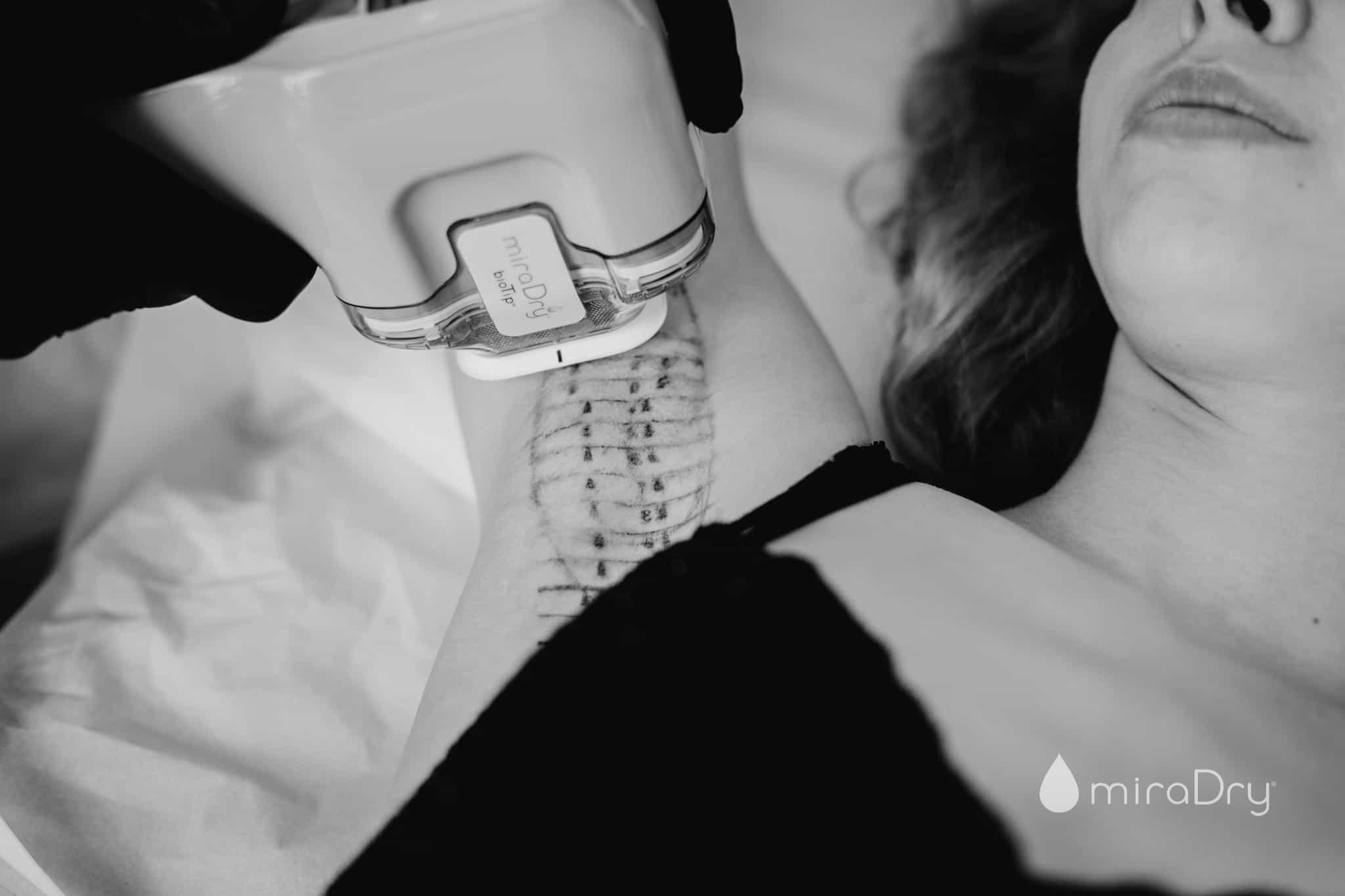
- Marking. A template is pressed onto each underarm to transfer a grid of marks; the manufacturer calls it a temporary tattoo, and in our experience it washes off over a few days.
- Anaesthetic. Local anaesthetic is injected in a grid across each underarm. This is the uncomfortable part of the appointment: the manufacturer's own manual says the injections will likely cause discomfort, and the technique has moved to larger volumes of a more dilute solution, which NICE noted was intended to lower the chance of nerve injury. The treatment starts at least ten minutes after the injections.
- The treatment. The handpiece is placed on each square of the grid in turn. Each cycle draws the skin up by suction, delivers the energy for a few seconds and cools the skin before releasing. You feel pressure and warmth; one underarm takes up to about twenty minutes. The manufacturer recommends its lowest energy setting for a first session.
- After. Ice packs wrapped in a towel go straight on, and you go home with instructions. In our experience most people go back to work the same or the next day.
One session or two, when you see the result, how long it lasts
| Feature | What to expect |
|---|---|
| Sessions | Usually one or two, three for some. The manufacturer says "as little as one treatment, optimal results in two"; NICE describes a second session about three months later as typical; in a retrospective 139-patient series from one Austrian clinic using the current protocol, 84% needed only one. In the pivotal trial most people had two sessions about two weeks apart on an older device |
| First change | Sweat reduction is measured from the first weeks; in the pivotal trial the first assessment was at 30 days |
| Main result | Measured at three months and held to twelve in the trials |
| How long it lasts | Twelve months of controlled data; 61% to 70% average reduction at about three years in an 18-patient survey; three-year improvement in a Swedish series with half the patients answering. The manufacturer says the glands do not grow back; the label makes no durability claim |
| Maintenance | In our experience none is scheduled; if sweating returns in part, a further session is the usual answer, agreed at the review |
At your consultation we tell you whether to budget for one session or two, and we review the result at three months, with a sweat test if you want one, before anyone books a second. A second session is not a failure of the first; NICE and the manufacturer both describe it as the route to the best result, although the 31-patient study found the result did not seem to depend on the number of sessions.
What miraDry costs in London
miraDry is priced per session, and a second session, if you need one, is usually charged again or offered as a package. Among the London clinics whose pages we read in , one session is advertised from about £1,395 to £1,650, with one offer page quoting a recommended price of £1,995: one Harley Street clinic lists "from £1,550" with sessions typically three months apart, one Guildford and London clinic lists £1,650 a session and says most people need one or two, and one central London clinic lists "from £1,395" on an offer page, against a recommended price of £1,995. An undated blog by a UK accreditation body quotes about £1,495 for one treatment and £2,800 for two; we have not been able to confirm it is current. Several top-ranking pages publish no price at all.
At our clinic the price depends on whether you plan for one session or two, so we quote it in writing at the free consultation, with what it includes. We price match any comparable written quote, and the consultation and every review visit are free whatever you decide.
A warning on offers. A low headline price for "a session" may be one of two you need, and the second may be charged at a different rate. Ask what happens if you need a second session, whether the anaesthetic and the reviews are included, who gives the anaesthetic and who holds the handpiece.
Consultations and follow-ups are free
Results you can check
The two photographs on this page are the manufacturer's and are labelled as such. At your consultation the clinician shows you what our own patients have reported, with their consent, and explains the starch-iodine sweat test, which turns sweating skin dark and lets you see your own result at three months. We do not publish patient photographs here.
Our reviews are collected through review.clinic, where you can read them. As of October 2026 they stand at 4.9 out of 5 from 82 reviews, with 100% of reviewers saying the treatment was worth it.
miraDry compared with the alternatives
| Feature | miraDry | Botulinum toxin injections | Iontophoresis | Surgery (ETS) | Antiperspirants and tablets |
|---|---|---|---|---|---|
| What it does | Heats the underarm sweat glands so they stop working | Blocks the nerve signal to the glands for a few months | Passes a weak current through water on the skin | Cuts or clips the sympathetic nerve chain in the chest | Aluminium chloride blocks the ducts; tablets reduce sweating everywhere |
| Sessions | 1 or 2, three for some | Repeated; the effect lasts 2 to 12 months, typically 4 to 9 | About four 20-minute sessions, repeated; effect 2 weeks to 3 months | One operation | Daily |
| Downtime | In our experience back to work the same or next day; swelling, lumps and numbness for weeks to months | None | None | Surgical recovery | None |
| Evidence | 82% average sweat reduction in a manufacturer-funded 31-patient study; 89% vs 54% responders against sham at 30 days in the manufacturer's trial | Well established; equal to miraDry on weighed sweat at one year in a head-to-head trial | Mainly for hands and feet | Most effective for hands and face; compensatory sweating in up to 75 in 100 after palmar surgery in one NHS leaflet | First line on the NHS; tablets cause dry mouth, blurred vision and bladder problems |
| On the NHS | Not usually available | In a few NHS centres | Yes, in some clinics | Yes, as a last resort | Yes |
| Suits | Underarms only, when antiperspirants have failed and you want to stop repeating injections | Underarms when you want a reversible, low-risk option | Hands and feet | Severe hand or face sweating after everything else | Everyone first |
The rows on sessions and downtime reflect the published protocols and our clinical experience; the evidence row names its sources.
miraDry vs botulinum toxin. In the Copenhagen trial, where each patient had one treatment on each side, botulinum toxin reduced weighed sweat more at six months, the two were equal at a year, and odour and hair reduction lasted only on the miraDry side; 76% of the patients preferred miraDry. The toxin is reversible and well understood, and it needs repeating once to three times a year. miraDry carries the risks of a one-off procedure, listed below, and no repeat injection courses every few months, though the local anaesthetic is injected at each session.
miraDry vs surgery. Endoscopic thoracic sympathectomy is effective for hand and face sweating but one NHS trust leaflet quotes sweating elsewhere in up to 75 in 100 patients after palmar surgery, severe in 1 in 100, and it is the last step in the NICE pathway. Removing or scraping out the underarm glands under local anaesthetic is another surgical option; in a systematic review, microwave treatment and liposuction-curettage both outlasted botulinum toxin, and microwave did better than liposuction-curettage in the short term. For underarms alone, surgery is rarely the first answer.
miraDry vs antiperspirants. Try the strong ones first. NICE lists aluminium chloride hexahydrate as first-line care, and many people never need more. miraDry is for the people it fails.
Consultations and follow-ups are free
The downsides: side effects, and the rare risks
Expect these, from the manufacturer's label: swelling or tightness, tenderness, redness and bruising from the suction and the injections, bumps under the skin, and altered sensation or tingling in the underarm and sometimes the upper arm. The label says most last a few days to a few weeks, and that the bumps, the tingling and a tight banding feeling in the underarm can last several months. In the 31-patient study, 71% had palpable lumps for a median of 41 days, 65% had altered sensation in the underarm for a median of 37 days, 90% had swelling for days to a week, and 26% lost some underarm hair. In the pivotal trial 10% had altered sensation in the upper arm skin for about two months, 5% had blisters, burns or ulcers lasting about a month, and 3% had lumps.
Less common, from the label: swelling spreading to the arm or torso, darkening of the skin, shoulder or arm soreness from lying still, a numb arm from the anaesthetic for under a day, shaking from the adrenaline in it.
Rare, from the label and the case reports: altered sweating elsewhere on the body (2 of 81 in the pivotal trial), small blisters or ulcers, altered sensation or weakness in the forearm or fingers that can last months, infection or abscess, burns, and nerve injury. Published cases include a thin 19-year-old whose arm nerve recovered almost fully over a year and a 49-year-old with a low body weight whose arm nerve injury was still severe eight months later. The doctors who wrote them up advise low energy and caution in thin patients. NICE's 2017 guidance said patients should be informed about the possibility of nerve damage during consent, and we do that in writing.
One more risk is on no clinic page we read: NICE noted in 2017 that the US regulator's adverse event database holds reports of nerve damage, infections, abscesses, burns and tissue death after this procedure. Nobody can turn them into a rate, because the number of treatments is unknown, and the manufacturer's count of treatments worldwide is its own figure. Read any safety summary next to the label, which is the document that counts.
Is miraDry available on the NHS?
Not usually. The NHS hyperhidrosis page does not mention it; the British Association of Dermatologists' 2018 patient leaflet says it is "not usually available as an NHS treatment in the UK". NICE's guidance on the procedure, published in December 2017 and not updated since, as far as we can find, says the evidence is inadequate in quantity and quality and that it should only be used with special arrangements for clinical governance, consent and audit or research. In practice you will find it in private clinics and not on a GP referral.
What the NHS does offer, in NICE's order: lifestyle measures and strong antiperspirants; then iontophoresis, botulinum toxin injections (in a few centres) or tablets; and surgery if those fail. If you have not tried a prescription-strength antiperspirant, do that first, with your GP or pharmacist, and ask them to rule out a medical cause.
How to choose a miraDry clinic
- Ask who gives the anaesthetic and who holds the handpiece. Ours are clinicians in a doctor-led team, and this guide is reviewed by Dr Marie Duggan, GMC 7488383.
- Ask what the price covers, in writing: one session or two, the anaesthetic, the reviews, and what a second session costs.
- Ask about the exclusions before you sign. Pacemaker or implants, oxygen, anaesthetic intolerance, pregnancy, previous underarm surgery, a very thin build.
- Ask which areas they treat. The label covers the underarms only.
- Treat the percentages as averages. The 82% is a mean in 31 people in a manufacturer-funded study; the 89% odour figure is unverified. Ask for the source of any number.
- Check the reviews, and where they come from. Ours are on review.clinic.
Aftercare
Ice packs wrapped in a towel on the treated skin for the rest of the day and as needed over the next few days, and an ordinary anti-inflammatory painkiller if you need one. Keep the area clean with water and a gentle soap, and skip shaving, deodorant and antiperspirant for a few days; when you go back to them, open a new product rather than one you used before. Loose tops while the area is tender. No vigorous exercise for about three days, on the manufacturer's advice. Expect lumps and some numbness to outlast the swelling by weeks, and tell us if you have pain that needs more than a shop-bought painkiller, a spreading redness, a blister, or weakness or numbness in the forearm or fingers, which we want to see promptly rather than at the three-month review.
Consultations and follow-ups are free
Frequently asked questions
How much does miraDry cost in the UK?
Among the London clinics we checked in October 2026, one session is advertised from about £1,395 to £1,650, with one offer page quoting a recommended price of £1,995; a second session, where needed, is usually charged again or sold as a package. We quote in writing at a free consultation, say what the price includes and what a second session would cost, and price match any comparable written quote.
Is miraDry worth the money?
If your underarm sweating is severe, antiperspirants have failed and you are spending on repeat injections or ruining shirts, one or two sessions may mean fewer repeat treatments: the trials show a large reduction in sweat for most people, held for a year in the controlled data and about three years in small follow-ups. If your sweating is mild, or mainly on your hands or face, it is not the right spend, and we will say so.
What are the downsides of miraDry?
The injections sting; swelling follows for days, then tenderness, lumps and numbness in the underarm for weeks, sometimes months; a minority respond only partly; and there are rare but real risks of burns, infection and nerve injury in the arm, which NICE says you should be informed about. The label's full list is in this guide.
Can you get miraDry in the UK?
Yes, in private clinics, including ours in the Harley Street medical district. It is not usually available on the NHS. If you are searching from Manchester, Birmingham or elsewhere in the UK, the treatment is one or two sessions plus a consultation and a review, and some people travel to London for it.
Can I get miraDry on the NHS?
Not usually. NICE's 2017 guidance calls the evidence inadequate and asks for special arrangements, and the NHS pathway runs through antiperspirants, iontophoresis, botulinum toxin in a few centres, tablets and then surgery. Private clinics are where you will find miraDry.
How many miraDry sessions do I need?
One or two. The manufacturer says results come from as little as one and are best with two; NICE describes a second session about three months later as typical; in a 139-patient series with the current protocol, 84% needed only one. We review you at three months before booking a second.
Does miraDry hurt?
The anaesthetic injections are the uncomfortable part, and the manufacturer's own manual says so. Once the underarm is numb most people feel pressure, warmth and suction rather than pain. Afterwards expect tenderness and swelling for days and some numbness for weeks.
Is there any downtime?
In our experience most people go back to work the same or the next day, and the manufacturer says exercise after about three days. The swelling lasts days to a week, the lumps and the numbness weeks to months, and a tight feeling in the underarm can last several months.
How long does miraDry last?
The controlled data run to twelve months, with the result held from three months to a year. Small follow-ups report a 61% to 70% average reduction at about three years. The manufacturer says treated glands do not grow back; the label makes no durability claim, so we do not promise you a result for life.
Does miraDry work for odour?
Probably, to a degree. In the 31-patient study the share of people who no longer noticed their odour rose from 13% to between 61% and 74%, and the Copenhagen trial found the odour reduction lasted a year. The one regulatory trial on odour missed its main target, so the label says only "may reduce underarm odor", and the "89% odour reduction" figure on some pages is one we could not verify.
Does miraDry remove underarm hair?
It reduces it. In the US the device is cleared for underarm hair reduction, with a 75% average reduction in hair count at a year in skin types I to IV; in the UK the manufacturer's stated use is sweating only. Expect less hair as a side effect, not as the aim.
Can miraDry treat my hands, feet, face or back?
No. The label says the device must not be used for sweating of other body areas or for generalised sweating, and the manufacturer's own wording outside the US describes its use as underarm sweating in adults. For hands and feet, iontophoresis is the usual first step; for the face, speak to your GP.
Will I start sweating more somewhere else?
It is possible but uncommon: in the pivotal trial 2 of 81 treated people reported altered sweating elsewhere, and the label lists it under rare reports. It is far more common after sympathectomy surgery, where one NHS leaflet quotes up to 75 in 100 after palmar surgery.
Who should not have miraDry?
Anyone with a pacemaker or other implanted electronic device, anyone who needs supplemental oxygen, and anyone who cannot have local anaesthetic with lidocaine and adrenaline. Treatment is discouraged in pregnancy and after underarm surgery, needs specialist advice with a metal implant, and calls for caution in very thin people and in anyone who heals poorly. Under-18s are outside the evidence.
Can teenagers have miraDry?
We treat adults. Every published study enrolled adults, NICE's guidance is for adults, and the manufacturer's stated use outside the US is in adults. For a teenager, prescription antiperspirants and the GP are the first step.
miraDry or Botox for sweating?
Botulinum toxin is reversible, well established and needs repeating every few months; miraDry is one or two sessions with a lasting result in the trials and the risks of a one-off procedure. In a head-to-head trial the two were equal on weighed sweat at one year and 76% of patients preferred miraDry. We do not offer injections, so if they suit you better we will tell you.
Where is the clinic and how do I book?
Sweat Hospital, 130 Harley Street, London W1G 7JU, in the Harley Street medical district, a short walk from Regent's Park, Great Portland Street and Baker Street stations. We are open Monday to Friday 9am to 7pm and Saturday 9am to 6pm. Consultations and follow-up reviews are free. Call 0207 043 1116 or use the form below. If you would rather be contacted by e-mail only, tell the team member who calls to book you and we will switch to e-mail.